Ask for a quote on a set of French doors and most online retailers will happily sell you a roller or vertical blind cut to the glass measurement, no questions asked. On a survey, that is usually the point we start again from scratch. Doors move — they open, close, get barged through with shopping bags and pushchairs — and the blind has to survive that while clearing a handle that can sit anywhere from 900mm to 1050mm up the frame. A window blind has none of those constraints. A door blind has all of them, plus the requirement that in an emergency somebody can still get out.
This guide covers the four fittings that genuinely work on doors — Perfect Fit, vertical blinds, tracked or bifold shutters, and where roller and Roman blinds are workable compromises — plus the measuring rules, safety regulations, heat performance and pricing that go with each. It reflects what we actually specify on surveys in Rochdale, across Greater Manchester, Lancashire, West and South Yorkshire and Cheshire, not a generic product list.
Why a door is a different job to a window
The first thing that catches people out is the handle. On a French door it typically sits at waist height, roughly a third of the way up the frame, and any blind fitted across the full drop has to either clear it, stop above it, or be mounted in a way that lets it operate around it without the fabric or slats catching every time the door is used. On a window that problem simply does not exist.
The second is traffic. A blind on a bedroom window might be raised and lowered twice a day. A blind on a back door that leads to the garden gets brushed past, pulled open with a free hand while carrying something, and generally treated far less gently. Anything with cords, tassels or a loose chain will eventually catch on the handle or a door hinge.
The third is the glazing itself. Modern French and patio doors are built with a thin aluminium or uPVC bead holding the glass into the frame, rather than the deeper reveal you get around a window. That bead is exactly what makes Perfect Fit blinds possible, and it is also why a standard recess-fit roller often will not sit properly on a door — there simply is not the depth of reveal to recess into.
Finally, there is egress. Building regulations and common sense both require that anything fitted to a door used as an emergency exit or a designated fire escape does not obstruct opening or closing. We check this on every door survey, particularly on French doors that double as the only rear exit from a ground-floor extension.
Perfect Fit blinds: the standout answer for uPVC doors
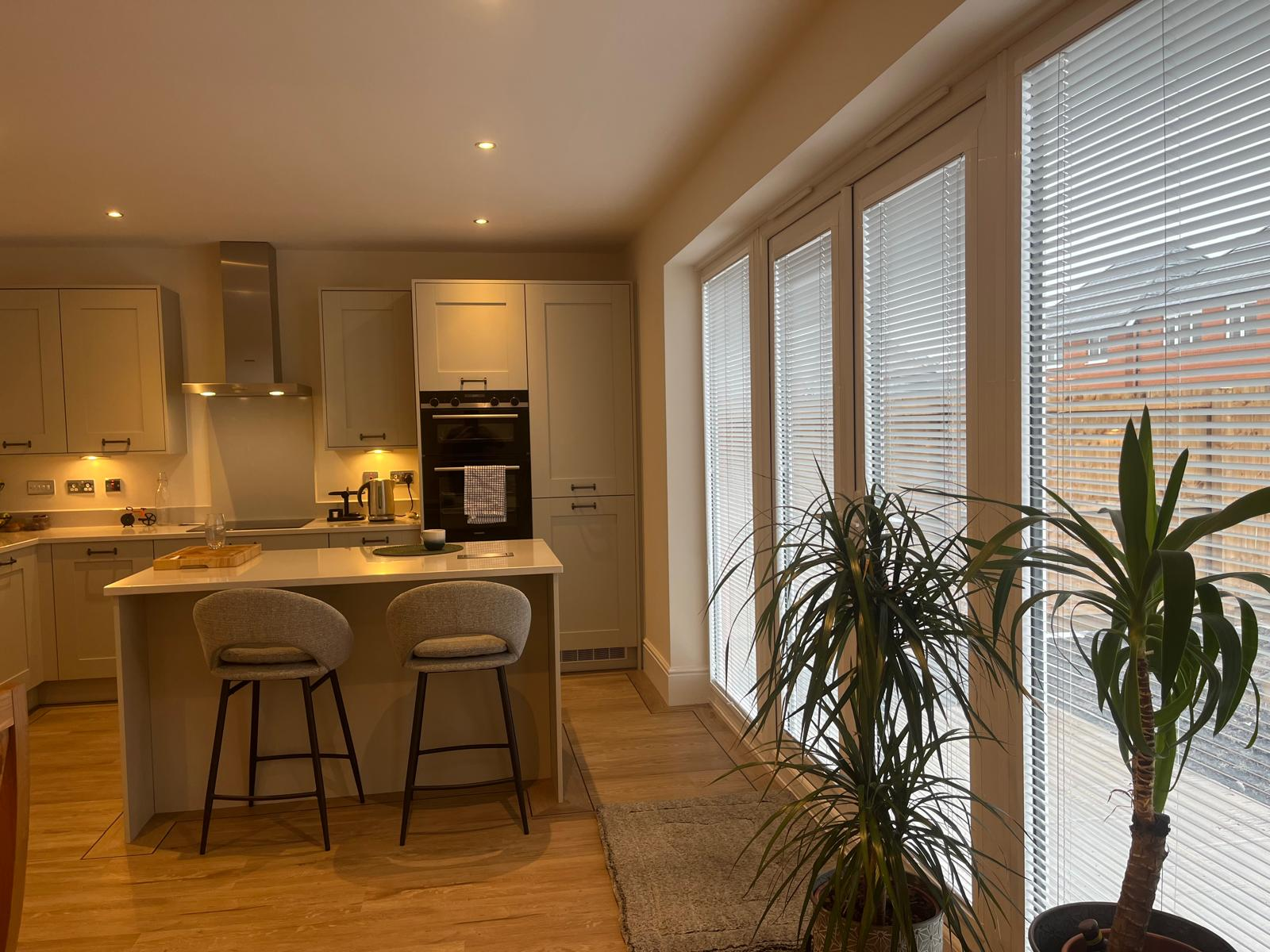
Perfect Fit blinds clip directly onto the glazing bead of a uPVC or aluminium door using a frame that grips the bead without a single screw or drill hole. The blind — usually a pleated or Venetian-style blind inside the frame — moves with the door, opening and closing as one unit, so there is nothing loose to catch on the handle and nothing hanging that a draught or a slammed door can disturb.
Because the frame clips to the bead rather than the wall or the door itself, Perfect Fit is the fitting we reach for most often on both French doors and single back doors in rented properties, new builds and anywhere the beading is in good condition. It leaves no marks if removed, which matters to landlords and to anyone who has just paid for new composite doors and does not want them drilled.
The trade-off is that Perfect Fit needs a sound, undamaged glazing bead to clip onto — an old or warped bead will not hold the frame securely, and we will say so at survey rather than fit something that will work loose within a year. It also sits close to the glass, so it gives good privacy and light control but is not a blackout product.
- —Clips to the glazing bead — no drilling, no screws into the frame.
- —Moves with the door, so nothing swings loose when opened or closed.
- —Best on uPVC or aluminium doors with a sound, undamaged bead.
- —Good privacy and light control, but not designed for full blackout.
Vertical blinds and wide sliding doors
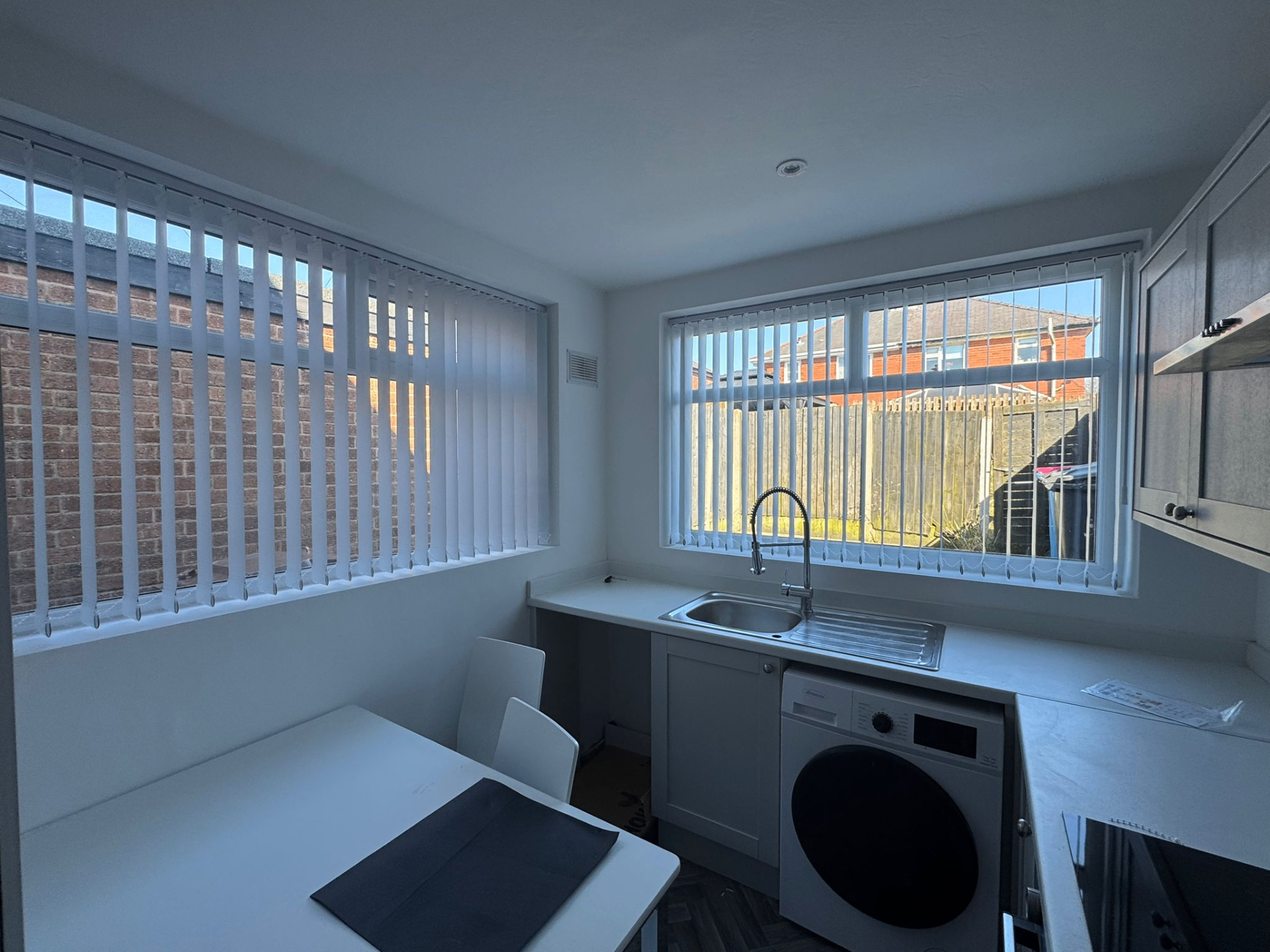
For wide sliding patio doors — the three or four-metre openings common on 1970s and 1980s extensions across the North West, and on newer bi-fold and sliding aluminium systems — vertical blinds remain a genuinely practical choice. The individual slats rotate to control light and privacy without needing to be raised, and when the door needs opening the whole stack draws to one side along a headrail, clear of the opening.
The detail that makes or breaks a vertical blind on a patio door is the stack-back — the width of wall or fixed glass the drawn slats occupy once pulled clear. On a sliding door with a fixed pane at one end, that fixed pane is usually where the stack sits, and there needs to be enough of it. Get the stack-back measurement wrong and the blind either fouls the moving door or leaves half the fixed pane permanently covered.
Verticals also cope well with direct sun on south-facing patio doors, since the slats can be angled to cut glare without blocking the view entirely, and heavier PVC-weighted slats resist the draught that flutters lighter fabric verticals every time the door opens.
Tracked and bifold shutters for patio doors
Where a client wants the shutter look on a wide opening rather than a blind, we fit tracked or bifold shutter panels rather than hinged window shutters. These run on a top and bottom track, so the panels concertina or slide clear of the opening in the same way as the door itself, rather than swinging open on hinges into the room.
This is a specialist configuration and needs accurate measuring of the track run and the depth available for the panels to stack, particularly where a patio door also has a fitted blind or curtain track already in place above it. Done well, it gives a patio door the same solid, made-to-measure look as a shutter on a window, with full privacy and genuine security benefit when closed and locked, plus the 10-year guarantee we put on every shutter installation.
We do not fit motorised shutters — motorisation on our installations is limited to roller blinds and Velux blinds — so tracked shutter panels on doors are always operated by hand. On a patio door used daily, most clients find that no real inconvenience once the track is set up properly.
Where roller and Roman blinds fall short on doors
Roller and Roman blinds are not ruled out on French doors entirely, but they suit doors that stay shut for most of the day rather than ones used constantly. A roller blind can be face fitted above a French door, but the fabric and bottom bar sit in front of the handle, so every time the door is opened the blind has to be raised out of the way first — fine for a rarely used dining room door onto a patio, frustrating for the main route to the garden.
Roman blinds have the same handle-clearance problem, plus a fold structure that catches draughts every time the door opens, gradually working the fabric loose from its lift cords over a few years of daily use. We do fit both on French doors where the client specifically wants the fabric look and is prepared to raise the blind before opening the door, but on a door used more than once or twice a day we will generally steer a survey towards Perfect Fit or verticals instead.
Measuring rules that matter on doors
Door measurements need to account for the handle position, the hinge side, and — critically on French doors — which leaf opens first, since blinds either side need to clear independently rather than as a single unit. We measure every door individually rather than assuming a matching pair is symmetrical; older French doors in particular are rarely fitted perfectly square.
On sliding and bifold patio doors we measure the full track run including any fixed panes, and confirm the stack-back space before specifying vertical blinds or tracked shutters, since this is the single most common reason a patio door blind ends up not fitting properly. All of this is checked on the free home survey, with a laser measure and an itemised written quote handed over on the day — there is no showroom fitting involved, everything is measured and specified in your own home.
Child safety and cord regulations on doors
Cord safety regulations apply with particular force on doors, because a door blind sits at exactly the height a child or pet is likely to reach for, brush past, or become tangled in. Any looped cord or chain within reach must be fitted with a tensioner or cleat, and on doors we generally recommend avoiding looped operation altogether in favour of cordless or wand-operated systems.
Perfect Fit blinds are typically wand or cord-free by design, which is a further reason they suit doors well. Vertical blinds use a wand for rotation and a separate cord for the traverse, both of which we fit with the correct safety devices. Tracked shutters are hand-operated with no cords at all. We check and explain the safety fitting for every blind on a door as standard, not as an add-on.
Heat, glare and cost on south-facing patio doors
A large south-facing patio door behaves like a greenhouse wall in summer, and the blind fitted to it needs to manage glare and solar gain as much as privacy. Vertical blinds with angled slats and reflective or PVC-backed fabrics cut glare without blacking out the view, which most clients prefer on a door they look through daily. Perfect Fit pleated blinds in a reflective fabric perform similarly on smaller French doors.
On cost, our blinds start from £95 fully fitted, and a straightforward Perfect Fit or vertical blind on a standard French door typically sits within a modest step of that, depending on size. Wide sliding doors needing multiple vertical blind headrails, or tracked shutter panels, cost more and are priced individually at survey — shutters throughout are £250 per square metre fully fitted. Every quote is itemised in writing on the day of survey, with a 50% deposit and the balance on completion.