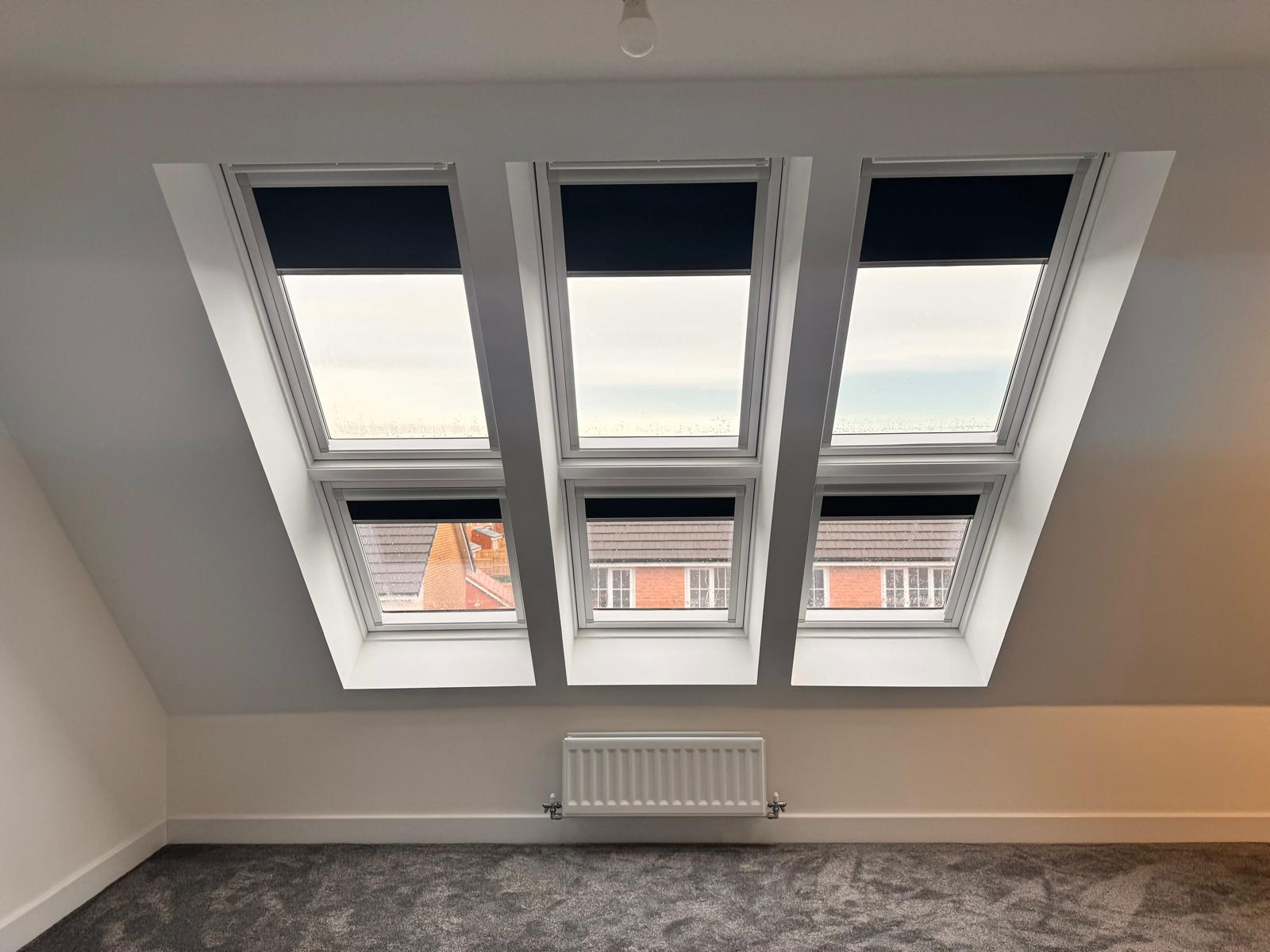
A Velux, Fakro or Keylite roof window catches direct sun for far more of the day than a vertical window in the same room, because it faces the sky rather than the horizon. In a loft conversion in July that turns into a genuine heat problem, not just a bright one, and in winter the same glass loses heat fast overnight. Add in the fact that most roof windows sit above head height, often over a bed or a desk, and you have a covering job with a different set of priorities to a standard living room window.
This guide walks through identifying your window so you order the right blind, the difference between blackout, pleated and solar-reflective fabrics, how side channels actually seal the light gap that plagues badly fitted roof blinds, the manual-versus-motorised decision, and the ventilation and condensation issues specific to loft rooms. We fit roof window blinds across Rochdale, Greater Manchester, Lancashire and the surrounding areas as part of our standard blinds range, from £95 fully fitted.
How a roof window is different from a wall window
Vertical glass receives sun at a raking angle for most of the day and gets genuine shade from any overhang or neighbouring building. A roof window, angled with the pitch of the roof, faces the sky far more directly, so it receives close to full solar gain whenever the sun is above the horizon on that side of the house. On a south or west-facing pitch in summer, a loft bedroom with an unshaded roof window can be noticeably hotter than the rest of the house by mid-afternoon.
Glare is a related but separate issue: even on an overcast day, the amount of open sky visible through a roof window is far greater than through a vertical one, which is why desks and beds positioned under a roof light often need shading on days that would not trouble a normal window at all. And because the window sits in the roof plane rather than at eye level, it is nearly always harder to reach for opening, closing and cleaning, which shapes a lot of the decisions in this guide.
Identifying your window: model and size code
Genuine Velux, Fakro and Keylite roof windows all carry a size code stamped or printed on the frame, usually on the top or side edge visible when the window is opened. Velux codes look like 'MK04' or 'CK02' — a letter pair followed by two digits; Fakro uses a similar alphanumeric code; Keylite prints a size reference in a comparable format. That code identifies an exact, standardised width and height, which is what makes ordering a correctly sized blind possible without measuring the glass by hand.
If the code has worn off or was never visible, we identify the window on site during the survey by measuring the sash and cross-referencing it against the manufacturers' size tables, along with checking the hinge and opening mechanism, since older roof windows sometimes take a different blind fixing bracket to current models even at the same nominal size. Never order a roof blind against a guessed measurement; a few millimetres out on a roof window blind is enough for the side channels not to engage properly.
Blackout, pleated or solar-reflective
Blackout roof blinds use the same dense, light-blocking fabric as a blackout roller, combined with side channels that close the gap along the sloped edges. In a loft bedroom this is usually the right choice — roof windows let in enough early-morning summer light to wake most people well before a normal alarm, and a true blackout roof blind with properly sealed channels solves that completely.
Pleated blinds concertina up and down rather than rolling, and are the standard choice for living rooms, studies and kitchens in a loft conversion where you want to filter and diffuse daylight rather than block it. Many pleated systems can be fitted top-down/bottom-up, so you can shade the upper glare-heavy part of the window while leaving the lower part clear, which suits a desk positioned under a roof light.
Solar-reflective fabrics have a metallised or light-coloured reflective face designed to bounce heat back out through the glass before it enters the room, and matter most on south and west-facing pitches where overheating, not light, is the real complaint. They are usually paired with a lighter overall look than blackout fabric and work well combined with a separate blackout blind for bedrooms that need both features at different times of day.
- —Bedroom, especially east or south-facing: blackout with side channels.
- —Study or living space under a roof light: pleated, ideally top-down/bottom-up.
- —South or west-facing loft prone to overheating: solar-reflective, paired with blackout if it is also a bedroom.
Side channels: the detail that actually seals the light gap
The single biggest complaint we hear about roof blinds bought and fitted without proper channels is light leaking down both sides even with a nominally blackout fabric. This happens because a roof window sash is set at an angle within its frame, and a blind without side guides has nowhere to register against; the fabric edge sits slightly off the frame and daylight finds the gap immediately.
A correctly specified roof blind runs in aluminium or plastic side channels fixed to the window frame itself, so the fabric edge is captured for the full length of its travel rather than simply hanging loose. This is standard on proper blackout and pleated roof-window systems, but is sometimes omitted on generic or cut-price blinds sold as a universal fit. If a roof blind you are considering does not mention side channels specifically, assume it will leak light down both edges regardless of the fabric's rated opacity.
Manual, electric or solar motor
A telescopic pole with a hook is the standard manual operation for a roof window blind, and works well for windows within comfortable reach — the majority of loft conversions with a standing-height ceiling under the window. It is the lowest-cost option and has nothing to go wrong electrically.
We fit motorised Velux blinds where the window is genuinely hard to reach — a steep pitch, a window set high above a staircase void, or simply a client who wants one-touch control alongside other motorised blinds in the house. Two motor types are practical for roof windows: a rechargeable solar-powered motor with a small panel that sits in the top of the glazing bar and trickle-charges from daylight, which needs no wiring and suits most retrofits; and a mains-wired electric motor, which needs a cable run planned before plasterboarding, so it has to be discussed at survey stage on a conversion that is still being built out, or accepted as a more involved retrofit on a finished room.
To be clear on scope: we fit motorised roller blinds and motorised Velux blinds, but we do not fit motorised shutters — if you want a motorised roof window alongside shutters elsewhere in the same loft room, the shutters will be manually operated and the roof blind can still be motorised.
Condensation and ventilation in loft rooms
Loft rooms run warmer and more humid than the rest of the house in a lot of older conversions, particularly where insulation between the rafters is dated or where a bathroom or en-suite has been squeezed into the eaves. A sealed blackout blind held tight against the glass by side channels can trap a layer of still, moist air against the coldest surface in the room, which is exactly the condition that produces condensation and, over time, mould at the base of the window.
Where a loft room already has a condensation issue, we will raise it at survey rather than fit a fully sealed blackout system and leave it to become a problem. Options include a slightly less sealed pleated blind that allows some air movement, making sure trickle vents or the window's own ventilation flap are not obstructed by the blind fixing, and simply flagging to the client that the room needs more regular ventilation regardless of what covering goes on the window.
Fitting, cleaning and cost
Roof window blind brackets fix into the window's own frame rather than the surrounding plasterboard, which is what makes them reliable on a sloped reveal — the bracket and the glazing bar move as one unit, so there is no risk of the fixing pulling out of soft plasterboard on a slope. We check the frame fixing points during the survey and confirm which bracket set matches the model and size code identified.
Roof windows are harder to clean and dust than wall windows simply because of their position, so we talk through blind choice with that in mind: a pleated blind's folds collect more dust over time than a roller-style blackout blind's flat surface, and a pole-operated manual system needs the pole kept somewhere it will actually be used rather than left in a cupboard downstairs.
Our roof window blinds start from £95 fully fitted for a standard manual blackout or pleated blind on a common size code, rising for solar-reflective fabric, side channel upgrades on older frames, and motorisation. Every quote follows a free in-home survey where we identify the window model, check the frame and ventilation, and hand you an itemised written quote on the day, with a 50% deposit and the balance on completion.